In the late 90’s, after completing my business degree and law qualification in London, I found myself at a crossroads. What should I do with my life and career?
I felt unfulfilled, directionless and in desperate need of something —something that would challenge me, confront me and help me find my place in the world.
What I didn’t realise at the time was that I needed an experience completely removed from anything I’d ever known. Something that would force me to stand on my own two feet, face challenges I’d never encountered in my sheltered existence and adapt to situations that were unfamiliar. I needed to experience life.
Into the unknown
And then, in 1997, I did. I went to Tajikistan.
The USSR had just collapsed, and Tajikistan, formerly part of the Soviet bloc, was still reeling from the aftermath. Tanks rolled through the streets, and people were adjusting to a new way of life, newly untethered from Russian control. It was raw, unfiltered reality, and I was right in the middle of it.
Working on behalf of an international development organisation, I arrived in Khujand, a small city in northern Tajikistan known for its ancient history as a key pitstop along the Silk Road. It felt like I’d been transported to another world.
Khujand’s ‘Hema Malini’
My mission was an ambitious one: to establish an English Language Training programme at the Khujand State University. Most of the city’s population had never met a foreigner, and almost everyone had heard of my arrival. If you’re familiar with Indian cinema, I was even nicknamed Khujand’s ‘Hema Malini’—a famous Bollywood actress. I didn’t think I looked like her at all, but hey, it made people smile.
Working with the university management was a challenge. They’d never worked with a young, single woman before and often didn’t take me seriously. It was frustrating, but I learned to push through. To find creative solutions. To make myself heard.
Language barriers were also present. While some spoke English really well, it was textbook English—formal, stilted and far removed from natural conversation. But that gradually changed over the weeks and months. Everyone wanted to chat, to learn, to understand where I was from and why I was there.
Building something to last
Many of the students had never seen a computer before, let alone used one. Something as simple as using a mouse was a completely new experience. But that’s what made being there all the more fulfilling.
Over several months, I oversaw the build of a language lab from scratch, complete with tape decks (yes, we used cassettes back then), headphones and a couple of desktop computers (which I’d helped to build myself, there was no IT support!).
Working closely with my Tajik colleagues, we set up a student office, developed resources, and provided invaluable language practice. It was challenging. Frustrating, at times. But also inspiring and deeply rewarding.
Immersed in Tajik life
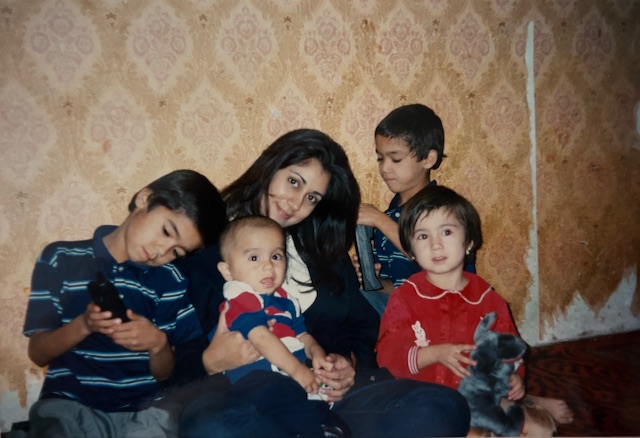
Experiencing the Tajik way of life remains one of my fondest memories. I lived with a Tajik family, ate with them at mealtimes, went to their family functions and weddings (there was a wedding literally every weekend).
There was no internet or mobile phones, so communication with my family back home was very limited. When Princess Diana died in August 1997, I had no idea. Nobody had heard about it.
I also had some bizarre and more sinister experiences—being grabbed on the street, followed by strangers and being treated by a traditional healer for food poisoning. Each of these moments, no matter how strange or unsettling, taught me resilience, courage and how to face whatever came my way.
Reflections that still inspire me
Years later, in 2002, I had an unexpected chance to return to Khujand. When I visited the university, I was so surprised to find the office and language lab I had set up still there, still being used. I’m still in touch with some of the students and colleagues I met there, and that’s something truly special. They’ve become lifelong friends.
Looking back, I can’t help but smile and feel a deep sense of nostalgia. My experience in Tajikistan gave me confidence and a sense of belief that I hadn’t understood about myself, and for that, I am eternally grateful.